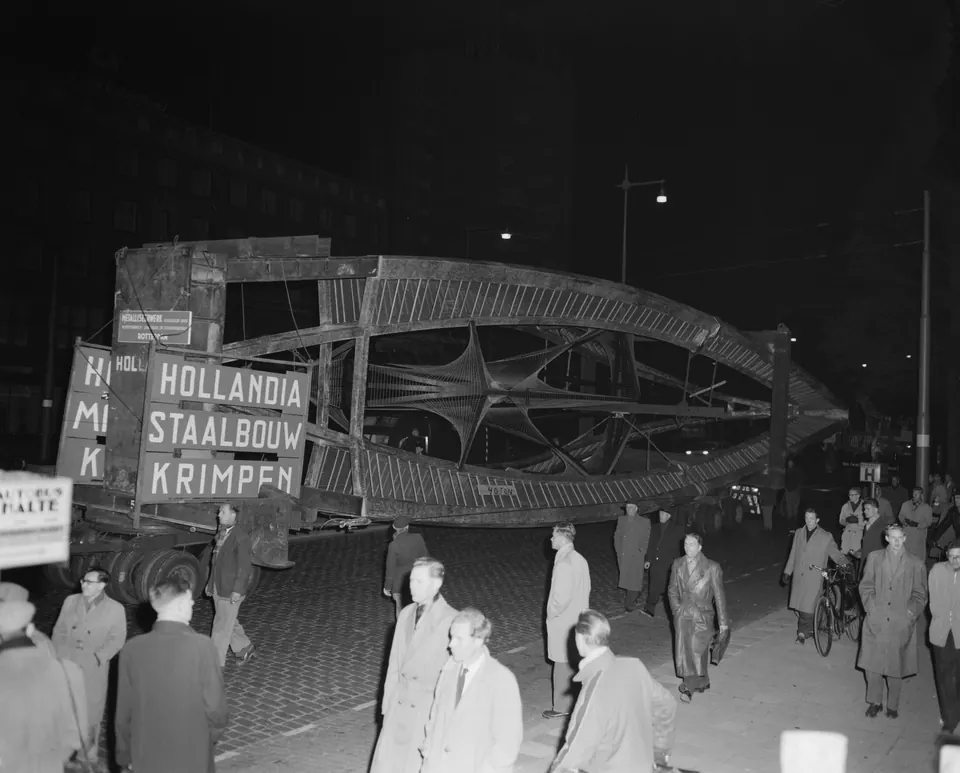
On 7 May 1957, a steel construction moved through Rotterdam at night.

The archive photograph is almost too good as a clue. A black form lies across a barge and lorry apparatus, part machine, part instrument, part public promise. The sculpture was Naum Gabo’s untitled construction for De Bijenkorf, twenty-six metres of steel profile, tube, and wire mesh on its way to the Coolsingel. It would stand beside a department store, not inside a museum, and it would ask an ordinary pavement to make room for constructivism.

That is where the route begins for me. Not with a manifesto, though there is one. Not with a clean theory of modernism, though Rotterdam can supply several. It begins with a city putting difficult art where shopping, traffic, grief, rebuilding, and weather would have to pass it every day.

Naum Gabo's steel sculpture for De Bijenkorf being transported through Rotterdam at night in 1957.
Gabo in transit, 1957.

Rotterdam had earned the right to distrust polite symbols. On 14 May 1940, bombs fell on the heart of the city from 13:27 onward. The official memorial page names the scale plainly: almost 900 dead, about 80,000 people without homes, and a centre that lost in minutes what had taken centuries to build. The old city did not simply become damaged. It became a question.

Henk Chabot saw the fire from the Rotte. His Brand van Rotterdam still matters because it does not tidy the event into civic mythology. It is smoke, heat, red sky, and witness. Walk a few minutes in Museumpark and you can still hold that contradiction: Chabot Museum’s white modernist villa, Boijmans beside it, the Kunsthal nearby, and the mirrored bowl of the Depot making storage itself public. Rotterdam’s museum district is not an escape from the city story. It is one of the ways the story kept changing shape.

CoBrA enters from another direction, like a wet handprint on a clean wall.

On 8 November 1948, six artists and poets met in Paris after a conference on avant-garde art had produced more frustration than future. Karel Appel, Constant, Corneille, Christian Dotremont, Asger Jorn, and Joseph Noiret signed Dotremont’s manifesto, La cause était entendue. The name CoBrA came from Copenhagen, Brussels, and Amsterdam. A movement was made out of cities, initials, travel, impatience, and the refusal to let official culture decide what experiment was allowed to look like.

Its romance is easy to overplay, so it is worth keeping the dates close. CoBrA was not a long empire of style. It burned hot from 1948 to 1951. Its artists published magazines, argued, painted together, absorbed children’s art, folk art, myth, graffiti, Art Brut, and the damaged freedoms of postwar Europe. They wanted directness: colour without apology, figures without academic obedience, painting that looked as if it had been made before embarrassment arrived.

The work can look innocent only if you ignore the year. After occupation, scarcity, censorship, and ruins, a painted creature with a blunt black outline is not cute. It is a refusal of cultural manners that had failed to protect anyone. CoBrA’s childlike energy was not nostalgia for childhood. It was an attack on the adult systems that had made themselves respectable while the world burned.

That is why Karel Appel’s force still feels connected to Rotterdam, even when the path is not genealogically tidy. Appel was Amsterdam-born, CoBrA was international, and Rotterdam’s reconstruction had many visual languages: modernist planning, port pragmatism, department-store patronage, sculpture, architecture, later graphic design. Still, Appel’s permission structure belongs in the same weather as the city. Red can be red. A mark can be rough. Public taste does not have to mean public meekness.

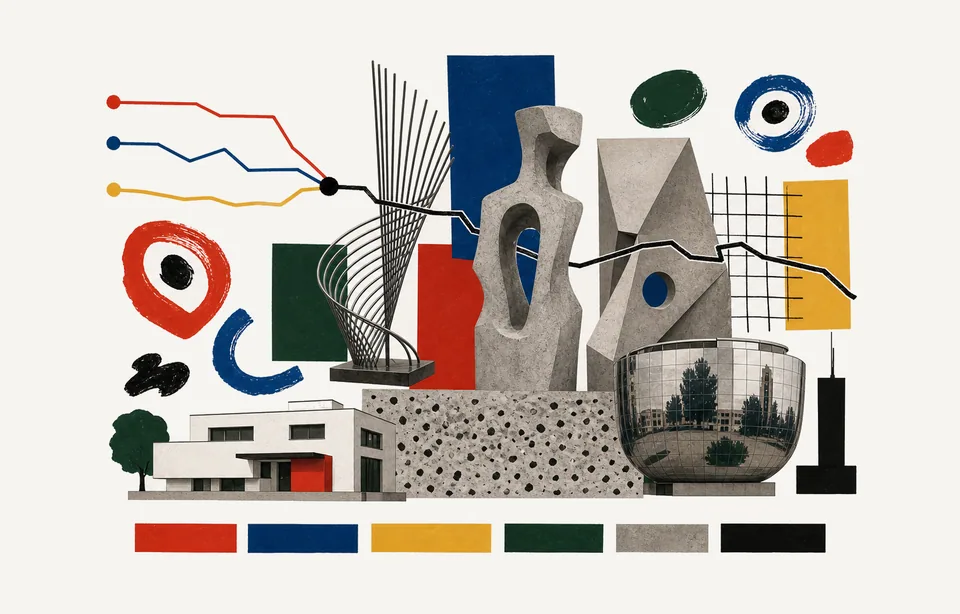
An editorial collage of Rotterdam route lines, CoBrA colour marks, Gabo-like steel ribs, a Zadkine-like hollow figure, concrete planes, a museum villa, and a mirrored depot bowl.
The route as an argument.

The other branch is colder at first glance.

Stockholm Design Lab began in 1998, long after CoBrA had been absorbed into museums, catalogues, and anniversary exhibitions. Its world is not Appel’s scraped paint. It is identity, signage, typography, brand systems, airport wayfinding, cultural institutions, product forms, and public confidence expressed through restraint. The studio’s strongest work does not ask colour to behave as decoration. Colour becomes architecture. Type becomes structure. A label can carry the authority that a weaker system would try to borrow from ornament.

It would be false to say CoBrA leads to Stockholm Design Lab. Movements do not pass a baton so neatly, and style history becomes silly when every resemblance is promoted into ancestry. The more useful claim is smaller: both show different ways of refusing timid visual culture. CoBrA refuses through instinct. Stockholm refuses through discipline. Rotterdam makes the comparison legible because it needed both.

Zadkine gives the route its wound.

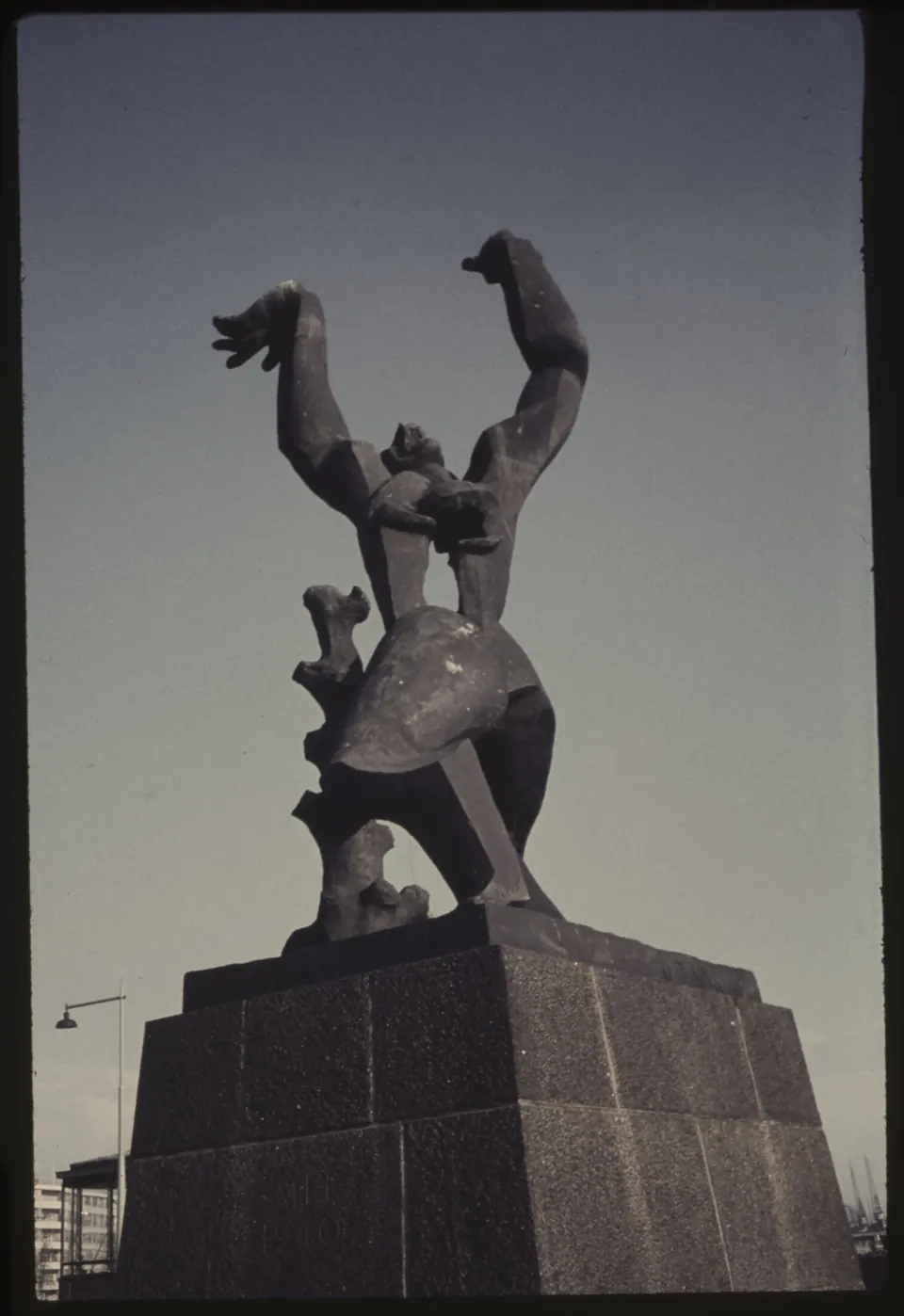
His The Destroyed City stands at Plein 1940 with a hole through its torso. The symbol is almost too direct, which is why it still works. According to Sculpture International Rotterdam, Zadkine said the idea came when he arrived by train in the devastated city in 1946. The figure is distressed, arms lifted, the heart absent. De Bijenkorf donated the enlarged bronze to Rotterdam; mayor Van Walsum unveiled it on 15 May 1953.

Many museums would protect a work like that from ordinary life. Rotterdam did the opposite. It put grief where people could disagree with it, nickname it, pass it, meet beside it, and discover one day that the hole in the figure had become part of the city’s mental map. That is a hard test for public art. A sculpture in a plaza has to survive weather and opinion.

Ossip Zadkine's The Destroyed City sculpture standing in Rotterdam in 1962.
The city's missing heart.

Gabo answers the wound with construction.

His sculpture at De Bijenkorf is not consoling in the same register. It does not show a body with a missing heart. It shows steel made almost weightless, a transparent form beside Marcel Breuer’s department store. Sculpture International Rotterdam describes it as around 40,000 kilos, which is a useful number because the work tries so hard to deny its own mass. It is heavy enough to require engineering and light enough, visually, to behave like a thought.

That pairing matters: Zadkine’s figure names what was lost; Gabo’s construction insists that the rebuilt city can accept abstraction in public. One mourns. One builds. Both came through De Bijenkorf, a commercial institution that understood, at least in that period, that rebuilding a city was not only a matter of selling goods behind glass.

From there the walk becomes less solemn without becoming unserious. Along the Westersingel, Picasso and Carl Nesjar’s Sylvette turns a painted sheet-metal model into reinforced concrete. The lines were made through concrete sgraffito: black aggregate exposed by sandblasting so that a drawing could become architecture. Critics complained that the work looked too much like a folded line drawing. That complaint is almost the point. Rotterdam kept accepting works that tested whether a public object could be both image and structure.

Picasso and Carl Nesjar's concrete Sylvette sculpture on the Westersingel in Rotterdam.
A drawing made public.

Public art in Rotterdam is not a garnish on the city. BKOR, the city’s public-art office, says no Dutch city has as much visual art in public space. Sculpture International Rotterdam’s walking route from Westersingel to Wilhelminapier names thirty works across a line from north to south, over the Maas, and into the port-facing modern city. That kind of collection changes the act of looking. Art is not only what happens after a ticket desk. It is what interrupts a commute.

Museums still matter, but in Rotterdam they sit inside a wider public argument. Chabot Museum keeps the expressionist witness. Boijmans carries the long collection. The Depot exposes the storage logic that most museums hide. Kunsthal, with its Rem Koolhaas building for temporary exhibitions, treats circulation itself as part of the display. Each institution has a different job. Together with the street works, they make art feel less like a protected class of objects and more like a civic operating system.

That is the connection back to this site.

The house style here has been moving toward a similar bargain: CoBrA energy inside Scandinavian structure. The page needs the rough mark because software, memory, cloth, weather, and personal history should not become bloodless diagrams. It also needs the grid because feeling without form becomes noise. The better version is not a compromise in the weak sense. It is a division of labour.

CoBrA supplies permission. Stockholm supplies manners. Rotterdam supplies proof that both can live in public.

Proof does not require every object to be beautiful. Some works will irritate. Some will age badly. Some will be defended too lazily because they have become landmarks. Good. A city that invests in public art is not buying universal agreement. It is accepting that shared space should include forms nobody requested and everyone has to learn how to read.

There is a quiet democratic seriousness in that. A museum can choose its audience. A public sculpture cannot. It stands in rain, outside office hours, in the path of people who have no obligation to be impressed. If it survives there, it has earned a different kind of authority.

Romance gives CoBrA a group of young artists refusing a dead culture with bright paint and stubborn animals. The grounded version is better. They were part of a broader postwar search for forms that could begin again without pretending nothing had happened. Rotterdam’s public art belongs to that same search, though it answered with bronze, steel, concrete, museum buildings, collection policy, and the long patience of municipal maintenance.

Stockholm Design Lab arrives much later as a cooler descendant of the same problem: how do you make a public visual language strong enough to carry institutions without turning them grey? The answer, at its best, is not more decoration. It is confidence. Red as field. Blue as field. Type as structure. Space as decision. Enough restraint that colour can speak at full volume without shouting.

That is why the line from CoBrA to Stockholm through Rotterdam feels less like influence than recognition. The rebel mark and the disciplined grid are not enemies. They are two answers to the same postwar question: after authority has failed, what kind of form deserves to stand in public?

Rotterdam does not answer in a sentence.

It leaves the evidence on the street.

Source Notes

Chris Chabot · June 2026