About
How I work, what I have built since 1994, and where the colour on this site comes from.
I have been building software professionally since 1994, when I started in Rotterdam, and most of that work has been about the same problem: what has to hold once other engineers depend on a system you are no longer watching. In 2008 that meant the PHP implementation of Apache Shindig and the OpenSocial and Portable Contacts specifications. Today, as a Member of Technical Staff, it means agent platforms, where the runtime, the SDK contracts, memory, permissioning, evaluation and verification all have to hold while software acts on its own.
What I work on
Agent execution and orchestration
Sessions, routing, workers and sub-agents, scheduling, durable execution, compaction and recovery, designed so that a long run survives a restart and a busy machine.
Verification and release engineering
Formal models tied to production behaviour, end-to-end acceptance, release gates, and recovery that has actually been rehearsed.
SDK and protocol design
TypeScript, Go, Python, Rust and Swift held to one contract, with conformance fixtures, capability negotiation and gates against incompatible change.
Memory systems
Durable tenant-scoped memory: recall, ingestion, consolidation and forgetting, with retrieval judged by whether the next answer is right and arrives on time.
Authority and security
Permissioning, scoped grants, secrets, authentication and idempotency, so that every tool action can be traced to someone who was allowed to ask for it.
Evaluation
Trajectories, replay, behavioural regression tests, paired statistics and cost per useful result, used to decide what ships rather than to decorate a benchmark.
Agent fleet operation
Decomposition, review, integration, tracing, spending caps and resource limits for many agents working on the same code.
Cross-team technical leadership
Specifications, interfaces and written decisions that other engineers can build against, and the explanation that gets them adopted.
How I work with agents
Much of the code behind this work was written by agents I directed, including agents running on the platform itself. I decide what has to be true and write it down, as a formal model, a conformance fixture or a checklist generated from the source. I break the work into pieces an agent can finish, and another agent with a clean context reviews each result before I read it myself. I integrate what survives and try to prove it wrong, with recorded sessions replayed through the new code, browser journeys a customer would take, and gates fixed before the run.
Built over time
Agent platforms
Porting a production coding agent
Port of a production coding agent under a formal model, per-module review and replay.
designed, directed, reviewed, verified, 2026
Release qualification for a cloud platform
Release qualification for an agent-native cloud platform, built around customer behaviour.
designed, verified, operated, 2026
The gateway that composes runtime, inference, workspaces and configuration behind one session.
designed, built, 2026
One protocol and conformance contract across five SDKs.
designed, led, 2026
A multi-tenant memory service in Rust, built on my public ports of mem0.
designed, built, 2026
Secrets and configuration authority
The platform's secrets and configuration authority: encrypted namespaces and run-scoped grants.
designed, built, led, 2026
Measuring agents before they ship
The loop that turns agent trajectories into decisions about what ships.
designed, built, 2026
Coordination, review and cost controls for more than a hundred agents at once.
designed, directed, reviewed, 2026
Products
Founding member of the project; led the platform's developer launch and API ecosystem.
contributed, led, from 2010
Twitter, Fabric, Crashlytics and MoPub
Led international developer relations across Twitter's API and its mobile stack.
led, from 2014
Public software
An MCP broker connecting live coding-agent sessions, with durable dispatch receipts.
designed, built, 2026
A Swift port of Codex with native macOS session isolation and supervision.
designed, built, 2026
Rust and TypeScript ports of Mem0’s core agent-memory pipeline.
designed, built, 2026
Cloudflare-shaped Workers and storage bindings running locally on Bun.
designed, built, 2026
Rust code search with BM25 lexical ranking and structured output for agents.
designed, built, 2025
A browser experiment implementing Obsidian’s Markdown-vault workflow.
designed, built, 2026
Chief author of the PHP implementation of the OpenSocial container; PMC member and committer.
built, from 2008
Standards
A common API for social applications across participating networks.
co-authored, contributed, from 2007
A simple XML and JSON protocol for address books and friends lists over HTTP.
co-authored, 2008
The framework for granting applications limited, scoped access to an HTTP service.
contributed, 2012
An interoperable answer to "who signed in?" on top of OAuth 2.0.
contributed, 2014
The API-description work that became the standard.
contributed
Background
For about fifteen years much of my work sat inside developer relations, where I led the developer launch of Google+ and then international developer relations across Twitter's API and mobile stack. It gave me a further strength: I can explain a platform to the engineers who have to adopt it, and I hear early where a contract or a document is going to let them down.
The work I want next is where agents are moving from demonstration to infrastructure: runtime and orchestration, memory, permissioning, evaluation and verification.
Rotterdam
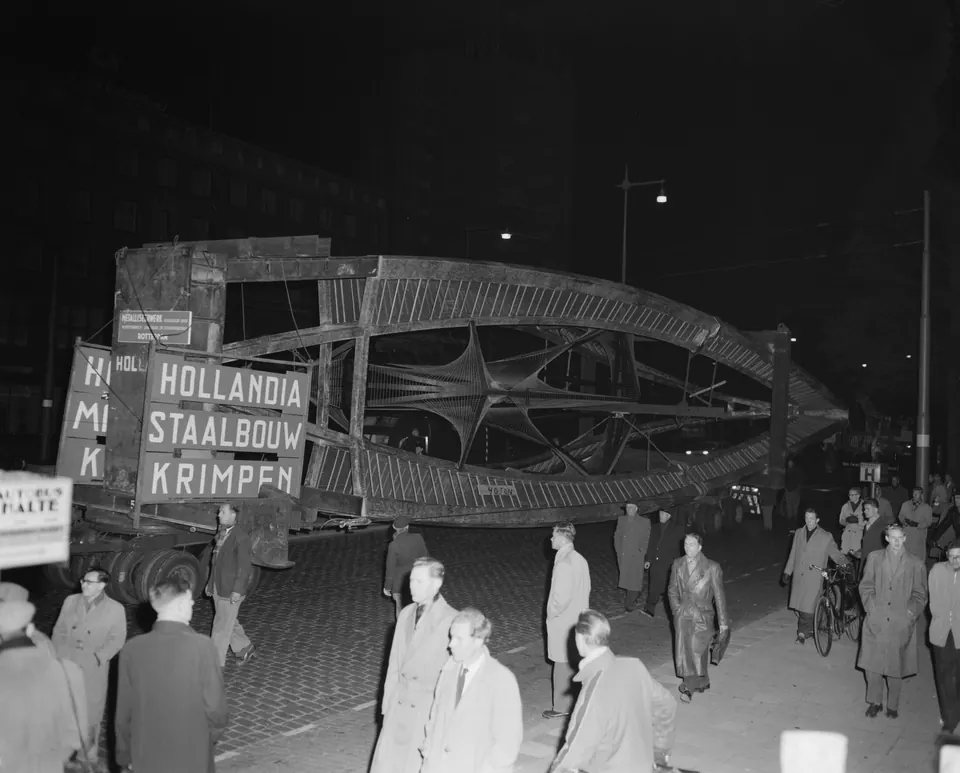
I grew up in Rotterdam, whose centre was bombed in 1940 and rebuilt around modern architecture, strong colour and public art such as Naum Gabo's steel construction and Ossip Zadkine's sculpture. When I was a teenager my mother took me to the city's museums, exhibitions and public art. Those visits and the post-war CoBrA painters, Karel Appel among them, were formative for me. The images on this site start from there: loose gestural paint, irregular contours and strong colour.
Contact
Based in London.